Robotics Lab

Robotics Lab

Robotics - Company

The laboratory, led by Dr. Navvab Kashiri, conducts cutting-edge research and development on next-generation robotic solutions across key areas including Intelligent Robotic Automation, Land Exploration Solutions, and Space Robotic Servicing. Leveraging expertise in manipulation, navigation, perception, and mechatronics, the lab integrates advanced technologies from computer science, control theory, mechanics, electronics, AI, and machine learning to develop deployable systems for high-stakes applications in industrial processes, space operations, and unstructured terrestrial environments.
 
The lab actively contributes to Leonardo's internal needs-including digital transformation initiatives-as well as to national and international projects (including EU-funded programs), fostering innovation in autonomous and resilient operations and human-robot collaboration/coordination, while supporting the company's aerospace, defense, and security missions.
 

Intelligent Robotic Automation


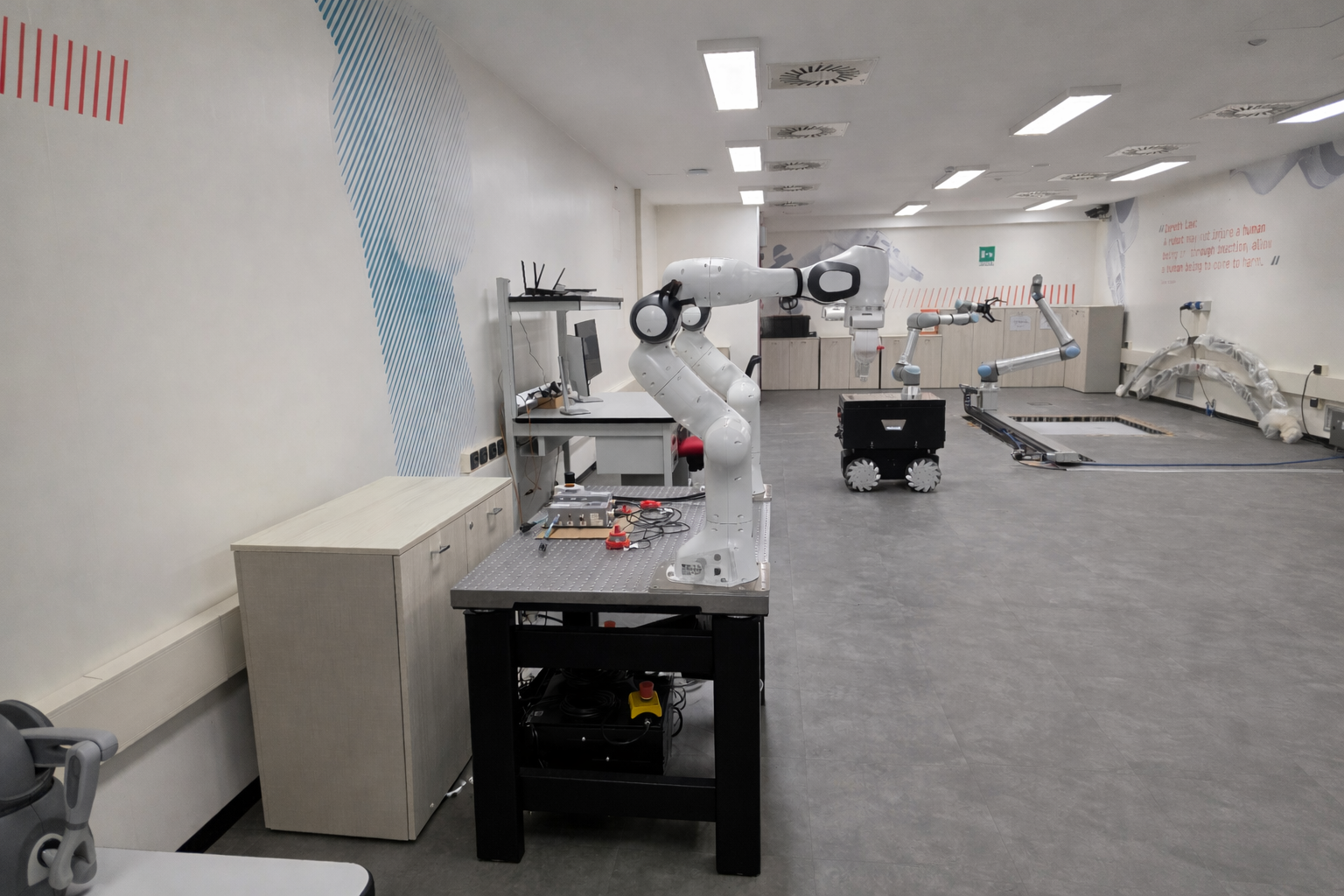
This research area, headed by Dr. Andrea Monguzzi, focuses on the incoporation of advanced robotics and AI into collaborative and industrial intelligence frameworks. This enables not only enhanced efficiency in complex industrial operations but also systematic, safe, and effective Human-Robot Interaction/Collaboration (HRI/HRC), especially in scenarios requiring tight coordination with human operators. The research centers on deployable solutions combining Autonomous Mobile Robots (AMRs) and robotic arms to boost flexibility, dexterity, and adaptability in manufacturing, maintenance and logistics.


What we do
  • Develop advanced autonomous mobile-manipulation systems with contextual task understanding and perception to enable precise, learning-based grasping, handling, assembly, and manipulation of diverse objects in dynamic and unstructured settings.
  • Advance manipulation techniques for complex and deformable items, incorporating force/tactile feedback, compliant control, and environmental contact exploitation for robust execution in precision-critical tasks such as aerospace assembly, component handling, or maintenance.
  • Design safe and intelligent human-robot collaborative frameworks featuring compliant interaction modalities, impedance/admittance control, and supervisory interfaces that ensure seamless coordination, preserve human authority, and support shared workspaces in safety-critical operations.
  • Create modular and reconfigurable manipulation hardware/software (e.g., interchangeable end-effectors, tool exchangers, adaptive grippers) for rapid task switching and adaptation across applications like component replacement, edge sealing, and flexible industrial processes.
  • Enhance logistics-oriented capabilities through AI-driven mobile manipulation, including object picking/packing, material transport, sorting, and flow optimization in warehousing or production environments, with emphasis on energy-efficient coordination between AMRs and fixed manipulators.
  • Develop predictive and reactive motion planning and control frameworks for robots operating in dynamic, obstacle-rich environments, enabling trajectory optimization, fast replanning, and safe, stable execution under uncertainty and disturbances.

Space Robotic Servicing

This research area, organized by Dr. Marco Puliti, focuses on the application of robotic technologies in space environments characterized by unique operational conditions including extreme environment, communication delays, and notable uncertainty. It augments operational intelligence via multi-functional modules and shared autonomy integration within tele-operation frameworks, while addressing challenges in tele-operation of remote systems through novel mediated solutions. The research targets evaluation and deployment in space exploration missions and In-Orbit Servicing (IOS) tasks (e.g., inspection, refueling, maintenance, debris mitigation), enhancing resilience and sustainability of orbital assets with applicability to planetary scenarios.


What we do

  • Design and prototype Smart Operational Modules with reconfigurable end-effectors (e.g., novel tool exchangers, multi-functional grippers) that embed advanced sensing, compliant control, and modular interfaces for flexible execution of diverse servicing tasks.
  • Develop unified Intelligence Core architectures and shared autonomy frameworks that fuse multi-sensor data with AI-driven perception and reasoning to enable robust situational awareness, explainable decision-making, and adaptive behavior under communication delays and uncertainties.
  • Validate technologies through high-fidelity simulation environments, digital twins, and Hardware-in-the-Loop testing to assess performance in realistic conditions, ensuring reliability, risk reduction, and confidence for IOS and exploration mission deployment.
  • Implement compliant contact manipulation strategies that exploit persistent satellite features for safe, non-cooperative grasping, docking, and intervention.

Land Exploration Solutions


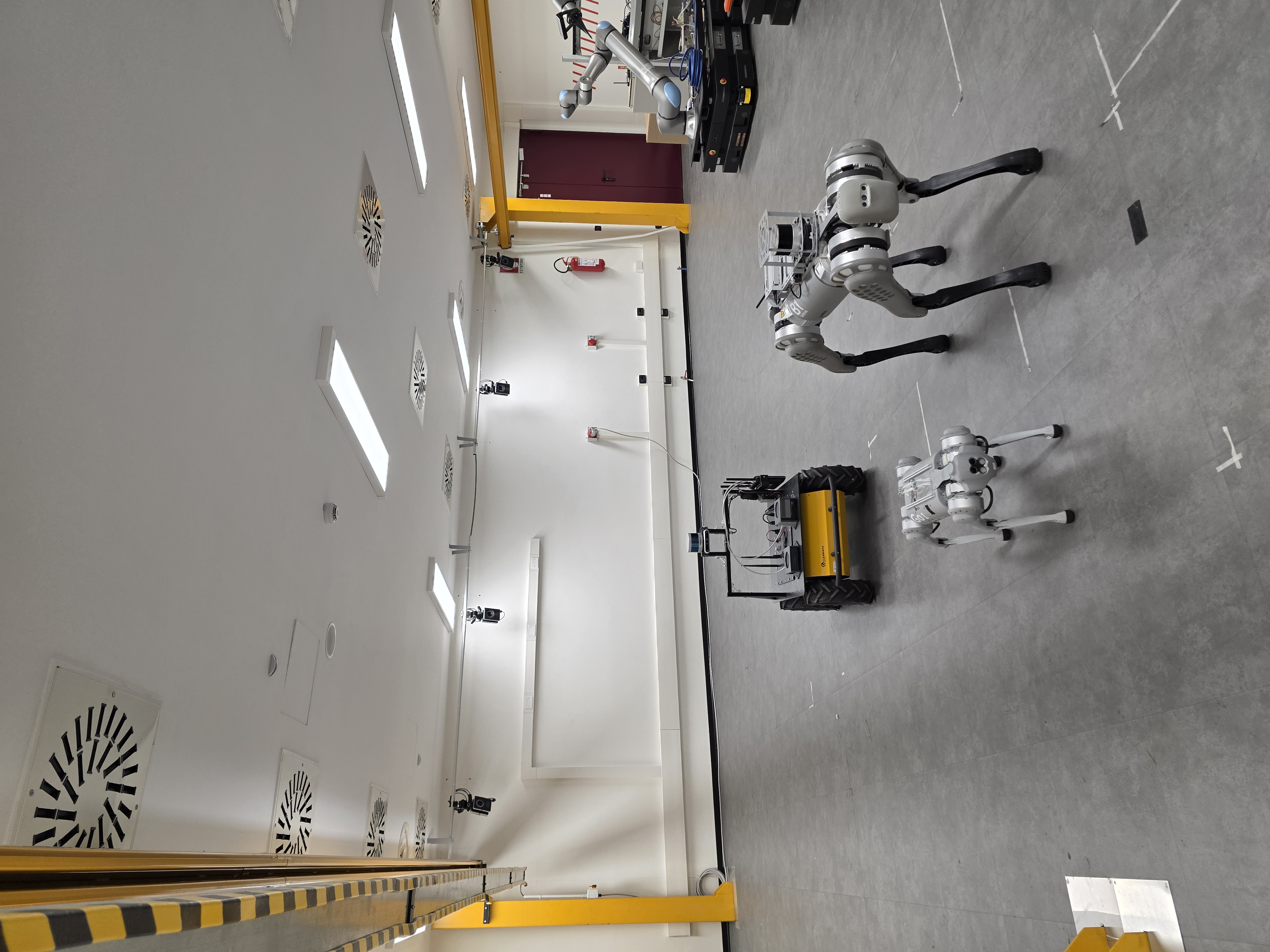
This research area, supervised by Dr. Federico Rollo, focuses on the development of AI and robotic technologies in challenging terrestrial environments characterized by significant uncertainty and/or physical hazards. It contributes to the development of advanced control, motion planning, and perception software (with potential hardware integration) for Unmanned Ground Vehicles (UGVs), including legged quadrupeds and wheeled rovers, to enable reliable execution of patrolling, monitoring, inspection, and intervention missions on uneven terrains, in security operations, disaster-response scenarios, or during emergency operations.
 

What we do

  • Advance perceptive navigation capabilities by integrating semantic mapping, multi-modal fusion, and interaction-aware processing to achieve resilient localization, terrain-relative navigation, and real-time scene understanding in uneven, dynamic, or perceptually degraded environments.
  • Develop adaptive mobility solutions through intelligent control architectures and hardware adaptations for hybrid wheeled-legged platforms, enabling energy-efficient, rugged traversal, dynamic obstacle negotiation, and robust locomotion on challenging terrains such as rubble, slopes, or unstructured natural settings.
  • Design robust autonomy frameworks that couple perception, planning, and control for semi-autonomous or supervised operation under isolation or communications degradation, with onboard AI for real-time decision-making, obstacle reasoning, and threat assessment.
  • Implement structured human-robot and multi-robot teaming protocols for cooperative behaviors, including distributed semantic mapping, shared detection cues, task allocation, and information fusion across heterogeneous UGVs while maintaining clear human supervisory authority.
  • Build AI-supported interpretation tools and decision-support systems that transform raw sensor data into actionable situational awareness for command-level applications in defense, civil security, disaster response, and infrastructure monitoring missions.

Results

4

Patents submitted/published

13

PhD students

7

Master thesis

Funded projects (current)

EC Project EuroQCI GROUND SEGMENT – OQTAVO
EC Project HORIZON-JU-RIA MATISSE
Topic
: Model-based engineering of Digital Twins for early verification and validation of Industrial Systems
DIGITAL EUROPE QUID
ESA Project HORIZON-JU-IA PROACTIF
Topic: Protecting People and Infrastructure with Next-Generation Unmanned Systems
Search overlay background

Mobile navigation menu