Financial highlights
Last trade 46.98€
Variation -1.40%
13/10/2026 - 05:36 PM
data source: Investis Digital
Financial highlights
Last trade 46.98€
Variation -1.40%
13/10/2026 - 05:36 PM
data source: Investis Digital
The award ceremony for the seventh edition of #T-TeC was held today in Rome, at the headquarters of the Italian Space Agency (ASI). The contest is an Open Innovation competition organised by Leonardo and Telespazio to foster technological innovation in the space sector among the younger generation of students and researchers from universities around the world.
Quantum systems for collision avoidance in orbit, artificial intelligence platforms for Space Domain Awareness, autonomous habitats for long-duration lunar exploration, vision-based navigation for lunar rovers: these are the themes at the heart of the projects selected by the jury from the submissions received for the 2025 edition of the contest.
The awards were presented by Massimo Claudio Comparini, Managing Director of Leonardo’s Space Division, by Gabriele Pieralli, CEO of Telespazio, and by Milena Lerario, CEO of e-GEOS. The ceremony also featured institutional remarks by Teodoro Valente, President of the Italian Space Agency.
Massimo Claudio Comparini, Managing Director of Leonardo’s Space Division, said: “The #T-TeC continues to prove itself as an accelerator of innovation and vision, capable of connecting young talent with the challenges of space. For Leonardo and Telespazio, investing in the next generation means building an open ecosystem in which ideas and skills are turned into concrete solutions. We firmly believe in this kind of initiative which, together with Space-focused hackathons, sustains a continuous exchange with the new protagonists, researchers and technicians of the sector. In this process, open innovation plays a central role: through a structured programme of technology scouting, we identify the most promising solutions and emerging skills at a global level, creating connections between the worlds of technology, innovation and industry. This is how the Space of tomorrow takes shape – by imagining, identifying and nurturing the best energies of the ecosystem.”
The seventh edition of #T-TeC recorded growing figures compared with previous editions: 23 proposals were received from 9 universities participating for the first time, bringing the total to 84 universities involved since 2019 and 25 countries represented. Since its launch, 526 young researchers and students have taken part in the initiative, with 153 proposals submitted across the seven editions. A growing community that confirms the #T-TeC’s capacity to attract fresh talent from an ever-wider range of geographies – so much so that this year the initiative was selected by the Ministry of Enterprises and Made in Italy for the Made in Italy Day.
The #T-TeC is under the patronage of ESA, ASI, AIDAA, AIAD, SGAC, CEAS and UKSA, and forms part of the Open Innovation activities promoted by Leonardo and Telespazio, which through the contest strengthens its shared innovation ecosystem in collaboration with universities, space agencies and research centres worldwide.
Two categories were open for competition – Idea, dedicated to projects at the conceptual stage, and Prototype, reserved for projects with a higher degree of technological maturity.
The first prize of €10,000 was awarded to the project Theia Sense, proposed by a team from the Politecnico di Torino – DISAT led by Alexandru Tancau, with Alberto Rovera and Giovanni Mingoia. The project proposes an integrated structural monitoring system based on fibre-optic sensors designed for extreme environments such as space. In addition to the cash prize, the team was deemed worthy of access to a three-month pre-incubation programme with Thales Alenia Space (Space Business Catalyst, Turin).
The second prize of €6,000 went to the project HORUS – AI-Powered Space Domain Awareness Platform for Space & Ground Infrastructure Protection, developed by Francesco Massa of the Sapienza University of Rome – Faculty of Engineering and Alessandro Aldini (advisor). The proposal integrates artificial intelligence techniques for monitoring and protecting space and ground infrastructures within a Space Domain Awareness (SDA) platform. The team was also selected for a pre-incubation programme with Leonardo.
The third prize of €4,000 was awarded to the project Modular Autonomous Closed-Loop Habitat System with AI-Based Analog-to-Orbit Validation Framework, presented by Salam Abualhayjaa of the Jordan University of Science and Technology (Amman, Jordan). The project envisions a modular autonomous habitat for long-duration missions, with an AI-based validation framework. Thales Alenia Space has expressed interest in continuing the dialogue with the team for possible future developments.
In the Idea category, the first prize of €5,000 was awarded to the project Satellite Defense in New Space: Quantum Algorithms for a Scalable Collision Avoidance Solution, proposed by Roberto Campos Ortiz of the Universidad Nebrija – Escuela Politécnica Superior in Madrid. The proposal applies quantum algorithms to the problem of collision avoidance in orbit, with a scalable approach designed for the New Space context.
The jury also awarded special mentions to four additional projects: LUMINA swarm (Lunar Universal Modular Intelligent Networked Agents, Politecnico di Torino – DIMEAS), addressing the critical need for an autonomous robotic workforce on the lunar surface; AION (ISITCOM – Sousse, Tunisia), a specialised hardware-software architecture designed to govern autonomous, high-precision manufacturing processes in the orbital environment; Autonomous Orbital Service and Intelligence Hub (AOSIH) (Tribhuvan University, Nepal), a distributed in-orbit service infrastructure for autonomous space operations; and DAEDALUS (Politecnico di Milano – Department of Aerospace Science and Technology), a modular vision-based architecture for autonomous navigation in lunar exploration.
In addition to the main prizes, the panel awarded further development opportunities: the projects GroupSat and TRUE SIGHT (both from the Politecnico di Torino) were selected for a six-month pre-incubation programme with ESA BIC Turin; KESSLER (University of Trieste – Astreo Team) and AIPER (Politecnico di Milano) for a four-month programme with ESA BIC Brindisi; and 3DMM (Sapienza University of Rome – Space Biomedicine Lab) for a four-month programme with ESA BIC Lazio.
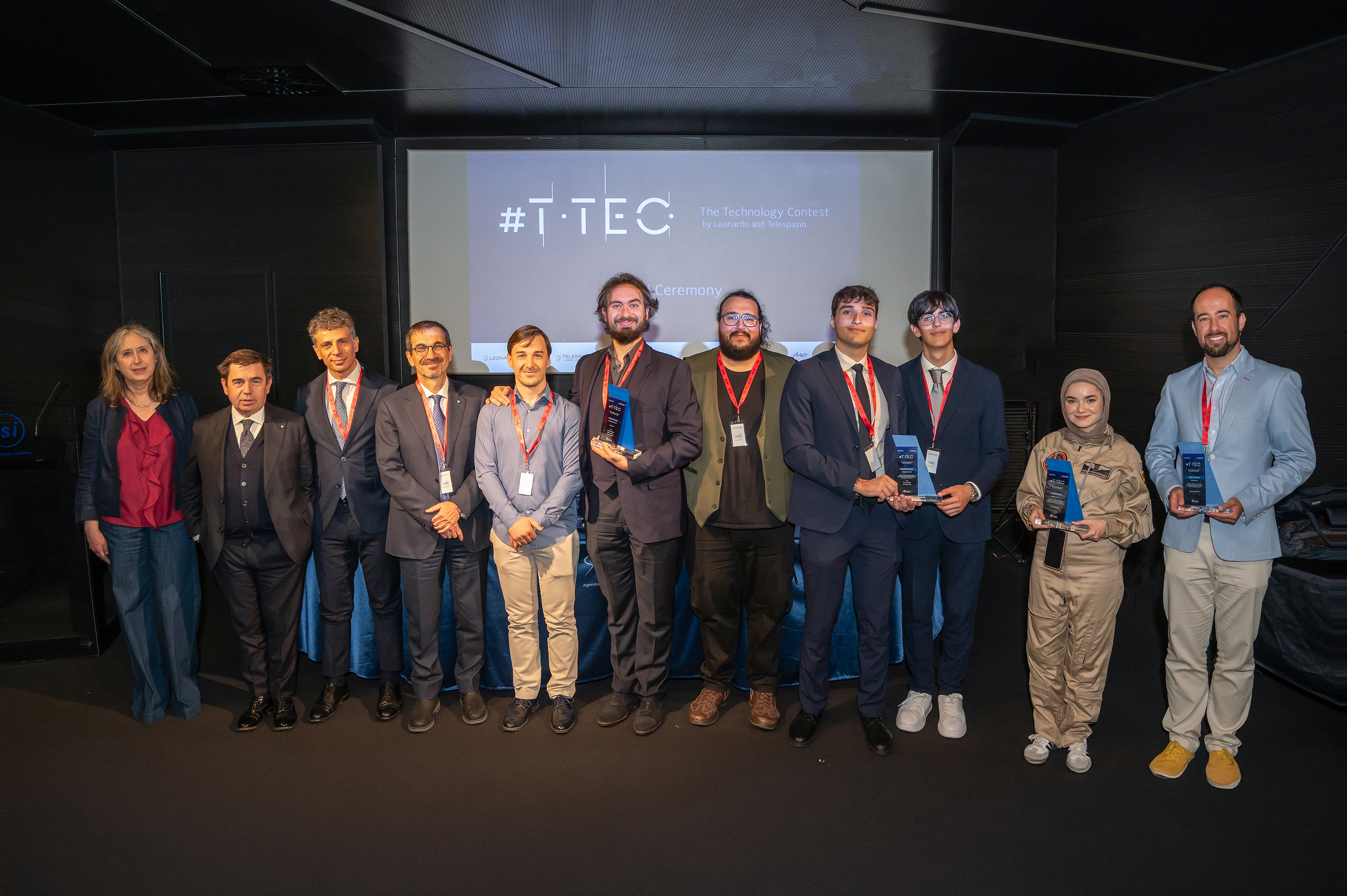
From right to left: Roberto Campos Ortiz (1st Place – Idea Category), Salam Abualhayjaa (3rd Place – Prototype Category), Alessandro Aldini, Francesco Massa (2nd Place – Prototype Category), Giovanni Mingoia, Alberto Rovera, Alexandru Tancau (1st Place – Prototype Category), Marco Brancati (SVP Technology, Innovation & Systems Architecture, Leonardo Space Division), Luca Petronzio (SVP Technology, Innovation, Telespazio), Massimo Claudio Comparini (Managing Director, Leonardo Space Division), Cecilia Sciarretta (Head of Product Policy & Open Innovation, Telespazio).

 media hub