Financial highlights
Last trade 49.19€
Variation -0.23%
20/10/2026 - 05:39 PM
data source: Investis Digital
Financial highlights
Last trade 49.19€
Variation -0.23%
20/10/2026 - 05:39 PM
data source: Investis Digital
(1) Not including Iveco Defence Vehicles consolidation
----------------------------------------------------
Rome, March 12, 2026 – Leonardo’s Board of Directors, under the chairmanship of Stefano Pontecorvo, yesterday unanimously approved the update to the Industrial Plan for the 2026-2030 period.
Today Leonardo is presenting to the financial community the update to the Industrial Plan to 2030, first announced in March 2024, including its medium-term targets.
“We have successfully met all the targets set out in our first Industrial Plan, exceeding all expectations. We now have platforms across every domain: land, space, naval and air, and we have invested heavily in digital technologies, AI and cybersecurity. Today we benefit from a competitive advantage that few others possess, enabling us to develop products and solutions capable of addressing future threats”, Roberto Cingolani, Chief Executive Officer and General Manager of Leonardo, commented.
“The new Industrial Plan defines the Group’s trajectory through 2030, with the aim of further strengthening our role as a high-tech player in global security. Today, Leonardo presents itself to the market as a unique industrial player, reinforced by the recent launch of the Michelangelo Dome, tangible application of the Group’s multidomain vision that will contribute to the development of sovereign and interoperable capabilities. An integrated and open defence architecture designed to address a security environment in which threats are increasingly hybrid and require new, fully interconnected solutions.”
The 2026–2030 Industrial Plan continues the growth strategy pursued by Leonardo over the past three years: becoming a multinational “One Company” with a clear, integrated and international industrial vision. The Group has been strengthened through the rationalization of its portfolio, the launch of new products, strategic international partnerships and joint ventures, selective M&A transactions, as well as strong digitization and enhanced production capacity. This path has enabled the Group to present itself on the global stage with a more solid structure, ready to seize the opportunities of a rapidly evolving market.
The update of the Plan to 2030 responds to a new context in which threats have changed in nature, speed and scale. Hypersonic missiles, ballistic vectors, drones and cyber-attacks are increasing uncertainty and operational complexity, requiring a paradigm shift: security no longer concerns only the traditional perimeter of defense, but directly affects the economic and social continuity of nations. Critical infrastructure, transport, agriculture, financial services, manufacturing, energy and chemicals are now exposed to interconnected risks capable of impacting growth and prosperity over the next decade.
Estimates confirm the scale of the challenge: the budget of global security is expected to increase from around USD 0.4 trillion per year in 2020 to more than 1 trillion per year by 2030, while the economic impact of cybercrime could rise from around 1 trillion per year in 2020 to 1 trillion per month by 2030.
For this reason, Leonardo intends to further strengthen its positioning as a leading player in Global Security, combining industrial leadership, innovation capabilities and the development of multi-domain dual-use solutions serving the security, resilience and competitiveness of national systems. Leonardo can rely on a renewed and comprehensive portfolio of solutions, developed both organically and through inorganic initiatives, capable of effectively addressing current and emerging global security needs.
The Michelangelo Dome represents a tangible application of the Group’s new multi-domain vision. It is a platform that leverages proprietary capabilities, assets and technologies across the air, land, sea, space and cyber domains, drawing on artificial intelligence, high-performance computing, cloud and data fusion. Not a single product, but an open, modular and scalable architecture that creates a dynamic “protective dome”.
Leonardo can therefore contribute to the protection of critical assets through a solution designed from the outset to be open to international cooperation and fully interoperable within the NATO framework. At the core of the system is MC5, a plug-in module that interconnects all domains, enabling interoperability, low-latency decision-making and integration with other existing platforms, including third-party ones.
Thanks to the Michelangelo Dome, Leonardo has the full capability to intercept, track and neutralize emerging threats across the entire operational spectrum: from ballistic and hypersonic threats to saturating attacks, as well as low-altitude and hard-to-detect threats such as large swarms of drones.
Michelangelo Dome is expected to unlock € 21 billion in new business opportunities over the next decade, including € 6 billion between 2026 and 2030 - already included in the updated Industrial Plan - and a further € 15 billion between 2031 and 2035, with expected impacts across electronics, cyber, drones, fixed-and rotary-wing platforms, platform integration, HPC/AI and new space systems.
The Industrial Plan to 2030 aims to position Leonardo as the high-tech group in global security with the most comprehensive portfolio in the sector. Cybersecurity, HPC, AI and data will form the backbone of Leonardo’s future trajectory. The Group intends to leverage its positioning by building on its capabilities to develop and market, alongside defense applications, a new generation of dual-use solutions for a range of sectors, including services for environmental emergency monitoring and precision agriculture.
With its workforce growing from 51,400 employees in 2023 to 62,700 in 2025, the Plan targets 67,300 employees by 2026 and 75,500 by 2030. After having hired 20,000 people between 2023 and 2025, over the 2026–2030 period, a further 28,000 hires are planned, with 55% expected to be under 30, 70% with STEM backgrounds and 30% women.
Over the past three years, Leonardo has launched a range of initiatives to attract talent and build strategic capabilities across its businesses. These efforts have strengthened the Group’s focus on STEM disciplines and include programs for high-potential young professionals developed in partnership with leading international universities and business schools.
At a time when threats are becoming increasingly complex and interconnected, human capital is the true competitive advantage. The new Industrial Plan is designed to strengthen capabilities in key areas, in line with a high-technology industrial model, further reinforcing the Group’s ability to innovate and compete over the long term.
The 2026–2030 Sustainability Plan, integrated into the Industrial Plan, aims to address the challenges of the evolving global landscape by strengthening sustainability as an enabling factor for competitiveness and resilience over the medium to long term. In particular, the Plan seeks to foster the development of technologies and integrated solutions for the protection of people, infrastructure and communities, enhance the efficiency and resilience of operations, and promote people empowerment, generating social impact.
Advanced technologies play a key role in the Group’s sustainable growth, through multi-domain solutions for global security and climate change adaptation, digital services and efficient technologies, flight simulation, solutions for the integrated monitoring of territories and urban areas, and increasingly digitalized customer services.
The Group strengthens its focus to decoupling industrial growth from resource consumption through decarbonization (reaffirming commitments to the Science Based Targets initiative), material circularity (with a new dedicated target), with particular attention to critical raw materials for the AD&S sector, and the digitalization and automation of production processes. The sustainability and resilience of the supply chain are also reinforced through objectives aimed at engaging suppliers in training activities and including ESG requirements in procurement tenders.
The Plan confirms and enhances the commitment to supporting the Group’s competitiveness by accelerating the diffusion of STEM and digital skills, key element in addressing the technological and industrial challenges of the coming years. It also reaffirms inclusion as a lever for nurturing distinctive professional capabilities and an enabling factor for attracting and developing talents.
For each business areas, Leonardo’s goal is to strengthen the core business and pave the way for the broader challenge of global security.
Electronics: to be a global player, a European leader, and a catalyst for European cooperation, through international partnerships with industry leaders, an optimized product portfolio, and the technological spillovers of the Global Combat Air Programme (GCAP). The electronics business is also the driving force behind the Michelangelo Dome and has a significant presence in the United States.
Over the course of the Plan, Defence Electronics sector - including Leonardo DRS and the strategic JV MBDA and Hensoldt - expects growth in orders, revenues, and EBITA of 4.8%, 8.5%, and 12.1%, respectively.
Helicopters: maintaining its role as global civil leader and military key player, upgrading the product portfolio through advanced technologies, manned and unmanned systems.
Over the course of the Plan, the Helicopters Division expects growth in orders, revenues, and EBITA of 4%, 3.7%, and 6.4%, respectively.
Aircraft: consolidating its role as leading player in the international cooperative programs GCAP and Unmanned Aerial Vehicle (UAV), with cutting-edge training services.
Over the course of the Plan, the Aircrafts & Service Business Unit expects growth in orders, revenues, and EBITA of 2.1%, 9%, and 7.6%, respectively.
Aerostructures: being the reference supplier for the main Original Equipment Manufacturers (OEM) of the sector, thanks to operational excellence and the capacity of further scaling up via diversification and strategic partnerships.
Over the course of the Plan, the Aerostructures Business Unit expects growth in orders and revenues of 12.9% and 17.8%, respectively, with EBITA breakeven expected by 2028.
Cyber: strengthening its position as European key player in cybersecurity and becoming a benchmark, paving the way to new frontiers in global security.
Over the course of the Plan, the Cyber Division expects growth in orders, revenues, and EBITA of 13.7%, 14.5%, and 21.5%, respectively.
Space: consolidating its European leadership on high-added value segments, leveraging Group capabilities and its own strategic alliances, to offer integrated and digitally advanced end-to-end solutions, which provide increasing benefits to the end customer. Reinforcing positioning to space surveillance, In-Orbit services in multi-domain environment. Within the Bromo initiative, the Space Division aims at becoming part of the most competitive European player of the sector, by joining forces with Airbus and Thales for a new, innovative, joint venture.
Over the course of the Plan, the Space Division expects growth in orders, revenues, and EBITA of 20.7%, 20.2%, and 26.4%, respectively.
FINANCIAL HIGHLIGHTS
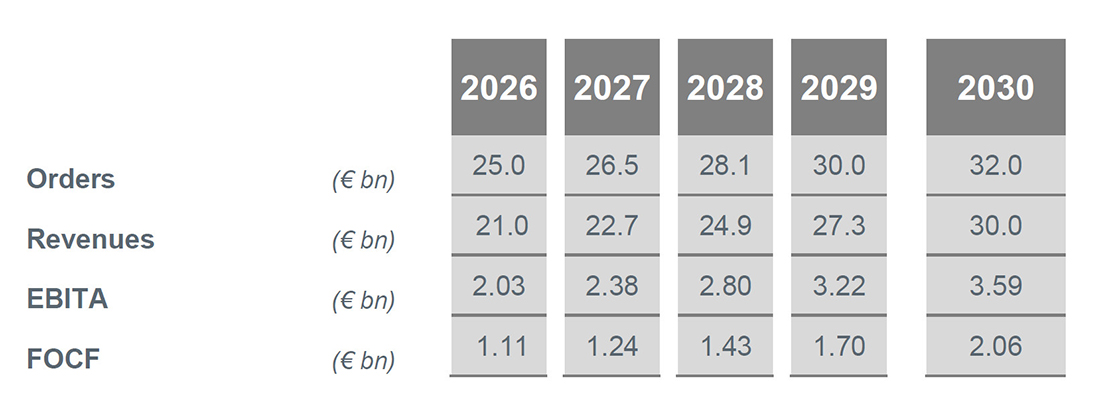
Not including Iveco Defence Vehicles consolidation
Based on the current assessments of the impacts of the geopolitical situation also on supply chain, inflationary levels and the global economy, subject to any further significant effects
ORDERS
REVENUES
EBITA
FOCF
CAPITAL ALLOCATION
The Group implements a disciplined capital allocation strategy to support growth and shareholder returns:
WEBCAST DETAILS
Leonardo is presenting its Industrial Plan today at 11:00am CET. Webcast details are available on Leonardo’s website, section Investor Relations (https://www.leonardo.com/en/investors/results-and-reports) where the presentation can also be downloaded.
SAFE HARBOR STATEMENT
Some of the statements included in this document are not historical facts but rather statements of future expectations, also related to future economic and financial performance, to be considered forward-looking statements. These forward-looking statements are based on Company’s views and assumptions as of the date of the statements and involve known and unknown risks and uncertainties that could cause actual results, performance or events to differ materially from those expressed or implied in such statements. Given these uncertainties, you should not rely on forward-looking statements.
The following factors could affect our forward-looking statements: the ability to obtain or the timing of obtaining future government awards; the availability of government funding and customer requirements both domestically and internationally; changes in government or customer priorities due to programme reviews or revisions to strategic objectives (including changes in priorities to respond to terrorist threats or to improve homeland security); difficulties in developing and producing operationally advanced technology systems; the competitive environment; economic business and political conditions domestically and internationally; programme performance and the timing of contract payments; the timing and customer acceptance of product deliveries and launches; our ability to achieve or realise savings for our customers or ourselves through our global cost-cutting programme and other financial management programmes; and the outcome of contingencies (including completion of any acquisitions and divestitures, litigation and environmental remediation efforts).
These are only some of the numerous factors that may affect the forward-looking statements contained in this document.
The Company undertakes no obligation to revise or update forward-looking statements as a result of new information since these statements may no longer be accurate or timely.

 media hub