
Financial highlights
Last trade 46.81€
Variation +2.21%
09/10/2026 - 05:37 PM
data source: Investis Digital
Financial highlights
Last trade 46.81€
Variation +2.21%
09/10/2026 - 05:37 PM
data source: Investis Digital
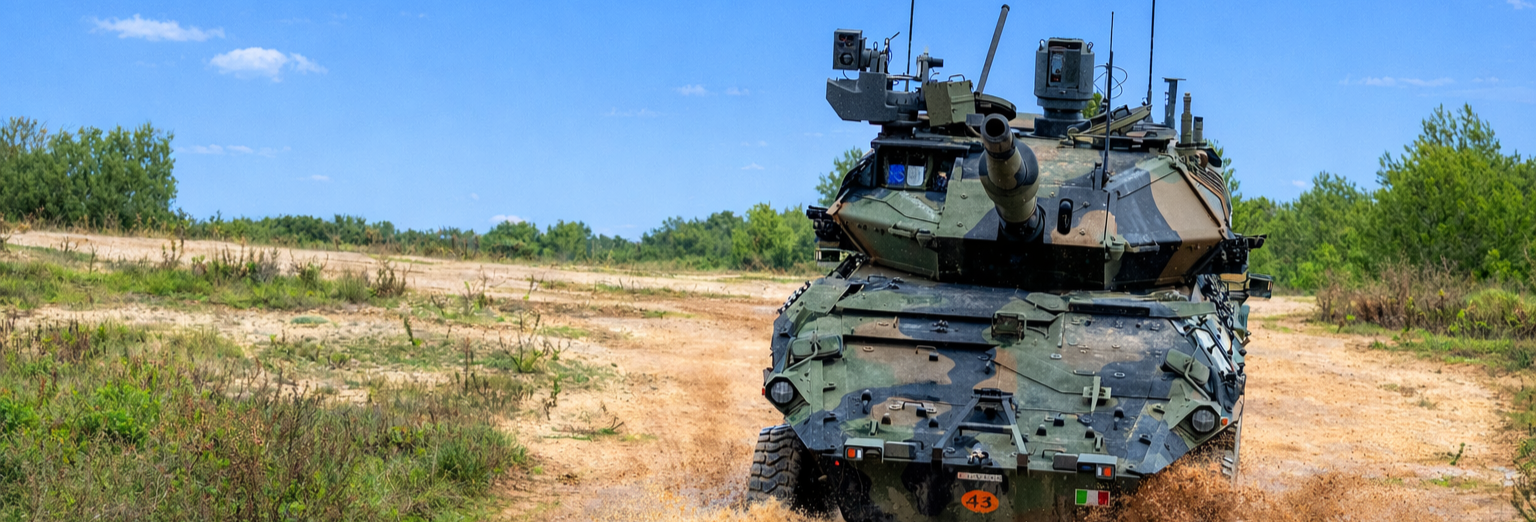
The ability to move, protect and coordinate forces in increasingly exposed scenarios is now one of the essential conditions for operational advantage in the land domain. This marks a paradigm shift from the single vehicle to an integrated system, in which vehicles, sensors, command and control, and effectors operate as part of a network.
Complexity and interconnection are the defining features of contemporary scenarios. Conventional threats, uncrewed systems, attacks from above, electronic warfare, cyber technologies and long-range munitions are compressing decision-making timelines and making operational continuity harder to maintain. A land platform can therefore no longer be considered as an isolated element: it must interact interoperably with other vehicles, sensors, command posts and mission systems.
This is where the need arises to move from vehicle to system: an evolution involving tanks, combat vehicles, artillery, radars, multi-role helicopters, deployable command posts and digital systems for battlefield management. The objective is to build a shared operational picture, reduce the time between threat detection and response, improve crew protection and enable units to operate in a coordinated way even in dynamic and high-intensity contexts.

A network of integrated capabilities
In the land domain, interoperability has a direct impact on the conduct of operations: it enables units, sensors and weapon systems to work on consistent, up-to-date information. A combat vehicle, a tactical radar, a turret, a command post and a battlefield management system deliver their greatest value when they contribute to the same mission.
This logic applies to the entire operational chain: sensors detect and track threats; command and control systems organise information and support decision-making; weapon systems and effectors provide the most appropriate response; land platforms and multi-role helicopters ensure mobility, protection, projection and operational continuity; deployable command posts make it possible to manage operations even close to the area of deployment.
The evolution of land defence is therefore about the ability to create a coherent set of capabilities. It is both a technological and operational transformation: it changes the way units collect information, share it, protect themselves and operate on the ground.
Land platforms: protection, mobility and integration
Combat vehicles continue to be an essential component of land operations. Their role is to ensure protection, mobility, engagement capability and resilience in complex scenarios. These characteristics are now joined by an increasingly important digital dimension: receiving, processing and sharing information, integrating with weapon systems, sensors and communications, and operating according to a network-centric logic while remaining connected to the command network.
Crew protection also depends on the ability to see earlier, understand better and react faster. On-board sensors, electronic systems, secure communications and digital architectures enable the vehicle to become a node on the battlefield, going beyond its traditional function as a manoeuvre or fire platform.
In this perspective, Leonardo’s land portfolio has been expanded through the recent acquisition of Iveco Group’s defence business, Iveco Defence Vehicles and ASTRA. This operation has enabled the Group to consolidate its position in the land defence sector and its role as an integrated Original Equipment Manufacturer (OEM), with a portfolio of complete solutions for defence and security on tracked and wheeled platforms, including Uncrewed Ground Vehicles (UGVs). Leonardo has also strengthened its position in land defence through its joint venture with Rheinmetall, LRMV – Leonardo Rheinmetall Military Vehicles. Reinforcing expertise in wheeled and tracked military vehicles makes it possible to work on on-board integration from the earliest stages of development, improving system coherence, protection, operational continuity and upgradeability over time.
Weapon systems and effectors: the last link in the chain
In an integrated land architecture, the weapon system is part of the platform and the mission network. It represents the last link in a chain that starts with threat detection, continues with assessment of the context and leads to the response. For this reason, turrets, artillery and engagement systems must interact with sensors, on-board systems and command and control.
The Hitfist 30 Uncrewed Light (UL) turret is an example of this logic. Fully developed through the integration of proprietary technologies, it equips combat vehicles and combines observation, aiming and engagement capabilities while keeping the crew protected inside the platform. In scenarios characterised by mobile, fast and hard-to-detect threats, effectiveness depends on the quality of the information available, the speed of the response and engagement precision, including against modern threats such as drones.

The same principle applies to artillery systems. The ability to operate in a coordinated way, receiving data from distributed sensors and entering a digital decision-making chain, becomes essential to reducing response times and increasing the precision of the effect.
An element of an operational chain that enables a response to be implemented against a detected threat. It may include protection systems, countermeasures or other tools that contribute to unit safety and mission continuity. In the land domain, its effectiveness depends on integration with sensors, command and control.
Radars and sensors: building the tactical picture
The first step in protecting units on the ground is the ability to detect and track what is happening in the operational space. Land sensors are required to detect a wide range of threats, differing in size, speed and behaviour, contributing to awareness of the scenario and supporting operational decisions.
The Tactical Multi Mission Radar (TMMR) responds to this requirement with a tactical radar capability designed for complex land environments and to intercept, classify and track small, agile objects. Its function is to contribute to the construction of a tactical picture that can be used by decision-making levels and response systems. In a context in which the time between threat detection and reaction tends to shrink, radar becomes an essential component of the operational chain.

Alongside radars, electro-optical systems such as Nerio add observation, identification and target confirmation capabilities. The combination of radar and electro-optical sensors improves the quality of information, reduces uncertainty and supports a more proportionate and coordinated response.
A radar designed to perform several operational tasks, such as surveillance, detection, tracking and support for defence against different threats. In the land domain, it can contribute to the protection of units, bases, infrastructure and operational areas.
Command-and-control: turning data into decisions
Collecting data is not enough: information from sensors, platforms and units must be fused, organised and made usable. This is the role of Command-and-Control (C2) systems and Battlefield Management Systems, the digital systems used to manage the battlefield.
In this context, digitalisation is not a separate layer but a cross-cutting component: it enables data management, contributes to the protection of information and supports operational effectiveness throughout the mission cycle.
The role of these systems is to support the construction of the operational picture, the distribution of information and coordination between units. They make it possible to visualise the position of forces, track the evolution of threats, assign priorities and connect sensors and effectors. In more complex contexts, they help maintain decision-making continuity even when communications are degraded or the operational environment changes rapidly.

Deployable command posts are part of this architecture. They provide planning, coordination and management capabilities close to the area of operation, while maintaining the link with units on the ground and with the higher levels of the command chain. In this way, command becomes a mobile, adaptable and connected capability.
The Command-and-Control system is designed to coordinate sensors, information and operational responses. Its function is particularly relevant in integrated architectures, where the speed of decision-making depends on the ability to correlate different data and turn them into coherent actions.
Artificial intelligence and machine learning are playing an increasingly central role in this architecture. By improving target detection, refining classification and supporting threat assessment and weapon assignment, AI enables faster and more effective responses to complex operational scenarios. Operators, however, remain fully in control of the engagement process, ensuring that technology strengthens — rather than replaces — human decision-making.
A set of processes, systems and tools that make it possible to direct and coordinate operations. In the land domain, it connects information, units, sensors and effectors
A digital system that supports battlefield management. It integrates data on the position of forces, threats, sensors, missions and communications, improving situational awareness and coordination.
Counter-UAS: an integrated chain against drones
The ability to turn data into decisions is particularly relevant in countering uncrewed systems. Small drones can be used for surveillance, target acquisition, disruption, attack or saturation, meaning coordinated uses designed to overload detection and response capabilities. Their spread increases the vulnerability of units, bases, convoys and infrastructure, requiring a response capable of integrating sensors, command and control, and effectors.
Countering drones, or Counter-Uncrewed Aerial Systems (C-UAS), requires an articulated chain, which Leonardo is able to provide across the entire workflow, from detection to engagement and neutralisation. The first step is detection, entrusted to radars such as TMMR. This is followed by tracking and identification, supported by electro-optical systems such as Nerio. The command-and-control level correlates information, assesses the threat and coordinates the response. Effectors, including Hitfist 30, can then intervene according to the scenario and the rules of engagement.
This represents a genuine transition from the single product to the system. Each element has a specific function, but operational value comes from their connection: detecting, identifying, deciding and responding within timelines compatible with the threat.
The vertical component supporting land operations
The scope of land operations also extends to the air component in support. Helicopters are an essential capability for tactical mobility, support to forces, surveillance, evacuation, transport and connection between distributed units. Their function is particularly relevant when operations require speed of movement, flexibility and the ability to intervene in hard-to-reach areas.
In an integrated logic, the helicopter acts as a mobile node in the operational network, bringing sensors, communications, protection systems and mission capabilities in support of land forces. The connection between platforms on the ground, rotary-wing assets and command systems makes it possible to extend the range of units and improve mission continuity.
This connection between land and air confirms the increasingly multi-domain nature of operations. Land capabilities must be able to interact with other operational environments, sharing information and integrating into broader surveillance, protection and response architectures.

A more connected land domain
The evolution of land defence follows a clear direction: protected and connected platforms, distributed sensors, integrated weapon systems, and command and control capable of supporting rapid decisions. The vehicle remains fundamental, but it becomes part of a broader system.
From vehicle to system, operational superiority is built on the ability to connect mobility, protection, observation, response and decision-making. It is this integration that makes the land domain increasingly connected to other operational environments, within the broader framework of multi-domain capabilities

 media hub




