
Financial highlights
Last trade 46.81€
Variation +2.21%
09/10/2026 - 05:37 PM
data source: Investis Digital
Financial highlights
Last trade 46.81€
Variation +2.21%
09/10/2026 - 05:37 PM
data source: Investis Digital
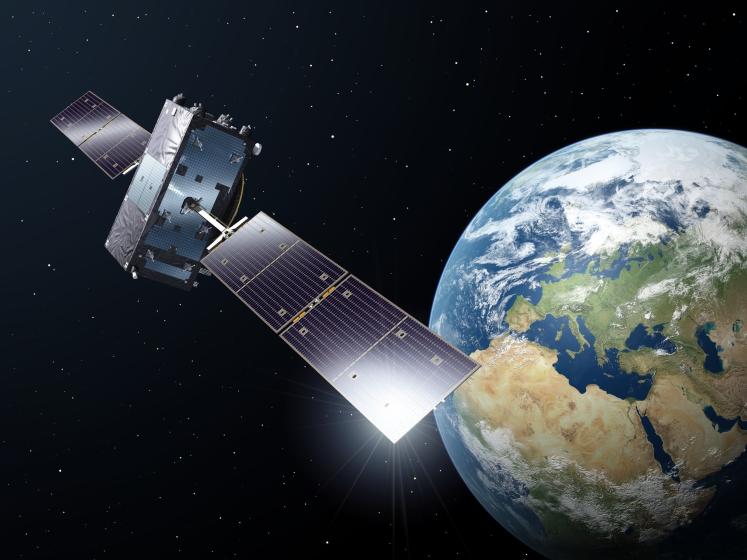
From emergency management to infrastructure security, through to the protection of assets in orbit and new space services, Space is becoming increasingly crucial for understanding complex phenomena and acting rapidly. Constellations, sensors, on-board computing, ground segments, geospatial services, Space Surveillance and In-Orbit Services are transforming the space domain into an operational capability connected to the other domains.
Environmental crises, critical infrastructure, maritime traffic, operational areas and territories exposed to extreme events require rapid, reliable and shared information. Space offers a unique perspective on these phenomena. However, the value of satellite data depends on the ability to acquire it, process it and make it available in time for those called upon to make decisions.
To meet this need, the space domain is evolving as an operational infrastructure to be monitored and protected: satellites acquire data, on-board technologies accelerate its processing, and ground segments and geospatial services transform it into usable information. It is a chain that connects Space to the other domains, making satellite data part of the decision-making process.
From observation to information superiority
Earth Observation is a cross-cutting capability, with civil and security applications: it supports environmental monitoring, emergency management, infrastructure protection, territorial security, and surveillance and intelligence activities. Satellite images make it possible to monitor the evolution of complex phenomena over large areas, including those that are difficult to reach using traditional means.
In this area, speed and continuity are crucial. Information transmitted late can lose much of its value; likewise, observation must be able to continue even when clouds, lack of light or complex weather conditions limit certain acquisition methods.
For this reason, the evolution of space architectures is looking to technologies capable of reducing revisit times — the interval between two observations of the same area — reducing data latency — the time required for data to become available to the end user — and ensuring continuous monitoring regardless of weather conditions or the day-night cycle.
Space Guardian, a new digital space infrastructure
This trajectory includes Leonardo’s first proprietary Earth Observation constellation, “Space Guardian”: a new-generation space infrastructure designed to integrate space and digital capabilities within a single architecture.
The programme envisages around 18 new-generation multi-sensor satellites, distributed across two orbital planes. The constellation is designed to ensure control over the entire data chain: acquisition through radar and optical sensors, possible future federation with other types of sensors, in-orbit processing and distribution to the end customer.
It is a model that goes beyond the traditional paradigm of the satellite as a data collection platform. Satellites become intelligent nodes in an orbital network, capable of processing and analysing information before sending it to the ground. Earth Observation remains the primary application, within an architecture also designed for digital sovereignty, data security and the resilience of space services.
The technological leap involves the entire infrastructure. On-board high-performance computing capabilities bring processing closer to where the data is generated. Optical inter-satellite links allow satellites to exchange information in real time, reducing dependence on passing over a ground station. This approach drastically reduces latency, enables immediate information processing and strengthens the security and resilience of the system, including against cyber threats.
The first orbital plane will include nine satellites: six with SAR (Synthetic Aperture Radar) payloads, two with very high-resolution optical instruments, and a communications satellite with an orbital router function, equipped with an Inter-Satellite Link to accelerate data download to the ground. The first launch is scheduled from the end of 2027. The second orbital plane, scheduled from the end of 2028, will complete global coverage with additional satellites, whose sensor configuration is currently being defined.
The combination of radar and optical capabilities enables more continuous observation of the Earth: radar sensors acquire data even through clouds or at night, while high-resolution optical instruments provide detailed images. The integration of this information improves the quality of the observation picture and makes it possible to respond to different needs, from environmental monitoring to security.
The production of the first satellites of Leonardo’s new Earth Observation constellation involves Thales Alenia Space, with integration, assembly and testing activities at the Space Smart Factory in Rome, a new-generation space factory oriented towards digital and automated processes. The ground segment, designed by Telespazio, also includes dedicated proprietary stations to support data management and distribution.
Value is created through the convergence of Space and digital technologies. Big data, artificial intelligence, cloud and analytical capabilities make it possible to process increasing volumes of information, identify anomalies, monitor the evolution of complex phenomena and generate information products suitable for different operational contexts. The operational chain connects acquisition, processing and distribution: the payload collects the data, on-board processing selects the relevant information, the links between satellites and the ground segment accelerate its availability, and geospatial analysis transforms it into knowledge to support decisions.
The expected applications of Space Guardian include the monitoring of critical infrastructure, maritime security, defence and intelligence, civil protection, and emergency and crisis management. The value of the constellation stems from its ability to connect space infrastructure, on-board technologies, the ground segment and geospatial services. Its architecture will be modular, scalable and federable with third-party systems, with capabilities interoperable with national and European programmes such as Copernicus, IRIDE and COSMO-SkyMed.
An integrated supply chain for the space domain
In the space domain, Leonardo combines space technologies, digital expertise and services through the Space Division and the joint ventures Telespazio and Thales Alenia Space. Its capability covers the entire chain: on-board instruments, space equipment, mission management, ground segment, satellite services, geo-information and data analysis.
Electro-optical payloads are an essential component of observation capability: they are the on-board instruments that acquire images and data from the Earth’s surface. Alongside these, space equipment enables the functions required for mission operation, from power management to on-board control, from navigation to communications, through to the overall reliability of the satellite. Atomic clocks ensure precise timing for navigation satellites, synchronisation and advanced satellite services, while space robotics extends operational capabilities towards exploration, activities on planetary surfaces, inspection, manipulation and, in perspective, in-orbit services.
This supply chain also develops through Telespazio and Thales Alenia Space, and with e-GEOS (20% owned by ASI) for geospatial services.
Monitoring and operating in Space
Alongside Earth Observation, the evolution of the space domain also concerns the protection of the orbital environment and the assets operating within it. Operational satellites, space infrastructure and essential services must deal with a more crowded environment, in which debris and space objects can pose a risk to the continuity, security and availability of missions.
Space Surveillance enables objects in orbit to be observed, tracked and characterised, contributing to the protection of space assets. Radar, telescopes, optical sensors, infrared sensors and tracking technologies make it possible to build a more accurate picture of the space environment and support assessments of possible collision risks.
This evolution also looks to space-based capabilities, with sensors integrated directly on space assets, and to In-Orbit Services: services in orbit designed for inspection, operational support, maintenance, extension of asset life and more sustainable management of space infrastructure. In this area, Leonardo has been selected by the European Commission for the development of SCOPE, one of the two specialised operational satellites, or “servicers”, of the In-Space Operations and Services (ISOS) programme, dedicated to use cases such as satellite inspection, repositioning, robotic manipulation and refuelling. Within ISOS, Thales Alenia Space in France has also been selected to develop the other servicer, EROSS SC, while Leonardo will make its space robotics expertise available to the EPRIME consortium, led by The Exploration Company, for the definition of the robotic systems of the orbital HOST. These activities are complemented by the expertise developed through the Italian Space Agency’s national In-Orbit Servicing programme, funded by the NRRP, and through ASIMOV, the EDF 2025 project led by Leonardo for in-orbit operations and services in support of European defence.
Protecting and operating in Space means safeguarding the capabilities that depend on Space: observation, navigation, communications, synchronisation, security and decision-making support.
Interconnection between domains
Activities carried out in the space environment enable a broader and more timely understanding of what is happening on Earth. Satellite data can support air missions, ground units, maritime surveillance, the protection of critical infrastructure and command and control systems, integrating with information from sensors, platforms and operational networks.
In a scenario in which the time between event and response is decreasing, the space domain strengthens the ability to connect observation, processing and data distribution, becoming an essential component of multi-domain architectures.

 media hub




