Financial highlights
Last trade 48.46€
Variation +0.28%
23/10/2026 - 05:35 PM
data source: Investis Digital
Financial highlights
Last trade 48.46€
Variation +0.28%
23/10/2026 - 05:35 PM
data source: Investis Digital
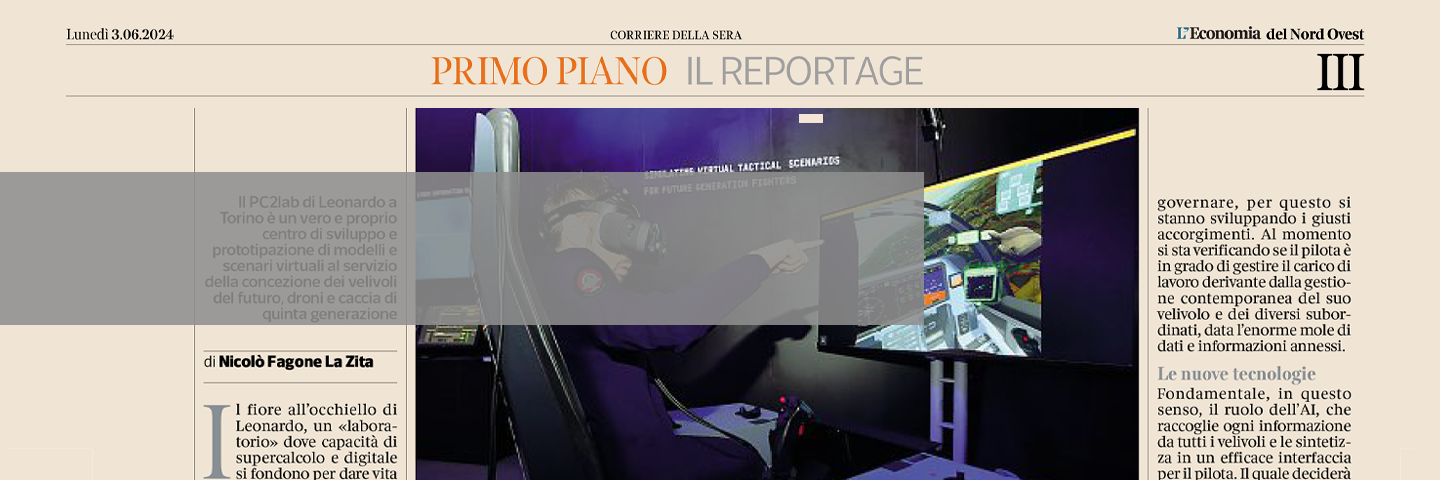
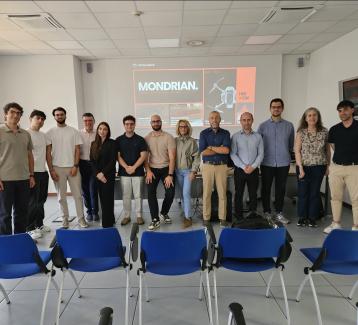
A simulation environment where real and virtual interact, where digital twins are developed to test aircraft in complex operational scenarios, long before they are actually flown. This is the technological challenge of virtual prototyping, which takes place within the PC2Lab (Product Capability and Concept Laboratory) in Turin. The story is described in an article by Nicolò Fagone on l'Economia de Il Corriere della Sera (Turin edition), which includes the statements of Cristiano Montrucchio, SVP Engineering at Leonardo Velivoli.
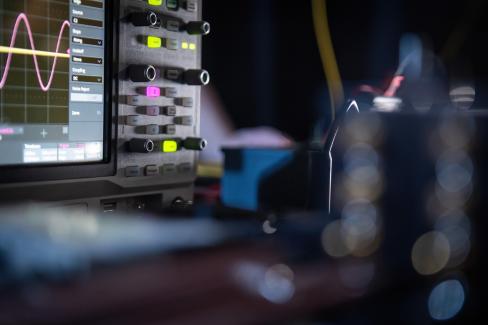
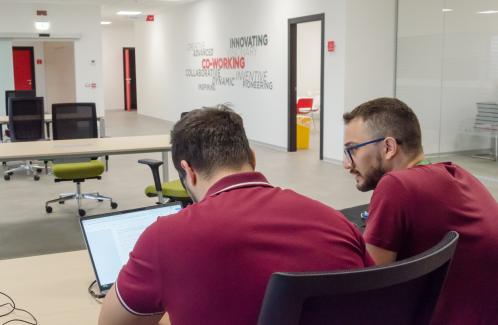
In Turin's Corso Marche, where the Aerospace City will be built, there is Leonardo's PC2Lab, a centre for the development and prototyping of virtual models and scenarios. Supercomputing and digital capabilities come together to give life to the aircraft of the future, drones and future-generation fighters. The laboratory is equipped with an extensive database capable of simulating scenarios in any part of the globe, with related weather conditions and the faithful reproduction of air, naval, land and cyber systems.
The PC2Lab enables the creation of the tactical scenario, within which the aircraft to be tested is placed. Once the scenario has been created, it is digitally reproduced - the digital twin of the aircraft - so that its efficiency can be verified in the context of the “system of systems” it belongs to and against the mission it has to perform. The generated scenarios provide a wealth of data and results, which will be analysed by Leonardo technicians and engineers, and processed thanks to the computing capacity of the davinci-1 supercomputer, the Group's technological enabler.
As Cristiano Montrucchio, SVP Engineering at Leonardo Velivoli, points out, "the goal is to create the best future-generation aircraft systems, which should be flying over the sky within the next twelve years". This is a real paradigm shift, as we are not talking about a single aircraft: at the heart of the future system is the collaboration between a piloted mother fighter and gregarious, uncrewed aircraft with a high range but under the control of the pilot.
Under this new approach, the role of artificial intelligence, which collects information from all the aircraft and synthesises it into an effective interface for the pilot, is crucial. The pilot will decide how many and which actions the wingmen can perform autonomously, while the final choice remains under human control.


 media hub