
Financial highlights
Last trade 50.42€
Variation +4.73%
16/10/2026 - 05:38 PM
data source: Investis Digital
Financial highlights
Last trade 50.42€
Variation +4.73%
16/10/2026 - 05:38 PM
data source: Investis Digital
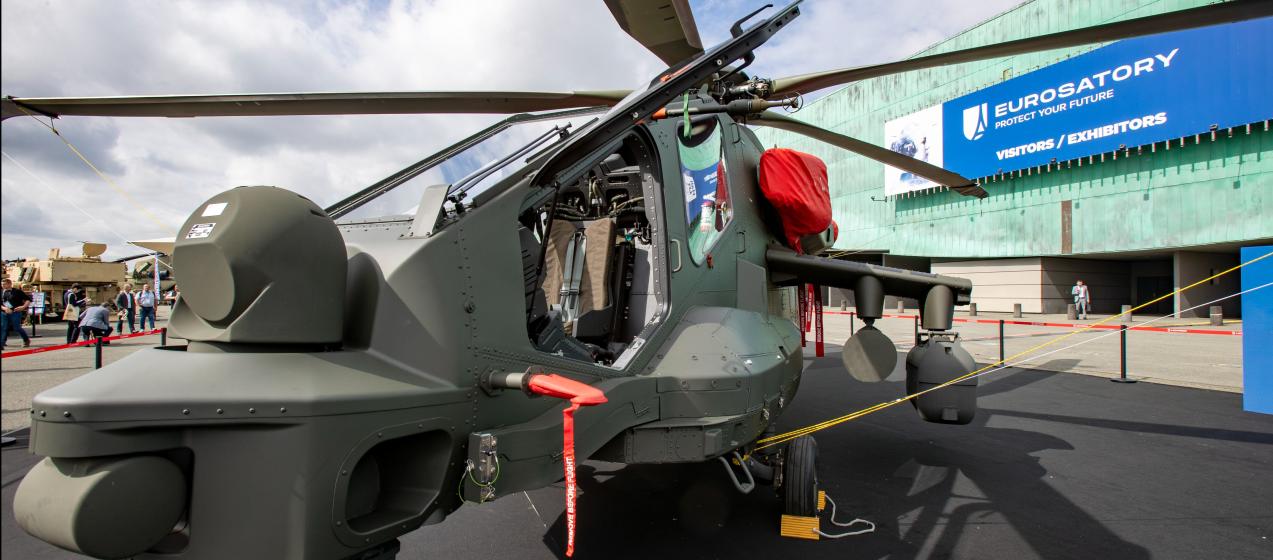
Two prototypes are flying, and two are in final assembly: the AW249 was created for multi-domain scenarios and future operational contexts, in response to the growing need for cross platform collaboration. The new helicopter was created thanks to an "agile" process - which allowed improvements and technological innovations to be made directly in the development phase - and is the result of a close synergy between the Italian Ministry of Defence and Leonardo.
Due to an increasingly frequent combination of conventional, asymmetric and hybrid threats, the speed of technological evolution and changing scenarios require the integration of information across all domains (earth, sea, sky, space, and cyberspace). The AW249 helicopter, intended for highly complex operations, emerged from this context. Named FENICE by the Italian Army, it stands out for its “agile” development process, which permits constant updating in the various production stages.

Its development results from the synergy and constant dialogue between the Italian Ministry of Defence and Leonardo, which has led to technical solutions based on actual operational needs, such as hybrid and unconventional threats. A decisive factor in this regard was the cooperation between AW129 pilots from the Italian Army Aviation (AVES) and Leonardo test pilots.
The helicopter’s development in the first stage benefited from a 1:1 scale mock-up, to assess accessibility, space, and the placing of EDCU (Enhanced Display Control Unit) and LAD (Large Area Display) panels in the cockpit.
A multifunction colour display with a large touch-screen surface for accessing functions and controls.
A display for managing primary flight functions.
The Mission Task Simulator (MTS) was then used to optimise the Human Machine Interface (HMI) and minimise the crew’s workload monitoring stress during mission simulations in various operational contexts.
The AW249 is designed to operate in complex and congested scenarios, in increasingly interconnected information and communication environments characterised by high-threat profiles (kinetic, cyber, and cognitive). These are so-called peer or near-peer scenarios, by which the threat has comparable levels of organisation and capabilities. They involve hard-to-reach strategic geographical areas, referred to as A2/AD bubbles (Anti Access/Area Denial).
Requirements of this type ensure the use of FENICE based on the logic and concept of multi-domain operations. For this reason, the helicopter is designed to offer a series of ‘native’ capabilities, already present in the aircraft which will be delivered to the Italian Army in 2027.

Data correlation to extract value from data for increasingly accurate responses.

Managing incoming and outgoing data and exchanging materials with airborne and surface platforms (land, sea).

Flight path control, position, and payload of the loyal-wingman drone (uncrewed aerial vehicle).


In comparison with the AW129, the helicopter features a greater range and speed, longer endurance in the operational area, and increased reactivity, manoeuvrability, and easy handling under all conditions. But what does this actually mean? It means that it can hide behind an obstacle or a row of trees, then rapidly perform evasive manoeuvres and escape, using the lay of the land. Or, moreover, to operate easily with greater awareness of environmental conditions, thanks to sensors and anti-collision systems, at high altitude and in high ambient temperatures.
Technology and systems responsible for a vehicle’s flight control, ensuring stability, manoeuvrability, and safety, allowing pilots precise movement control.
At the heart of the system is a next-generation Battlefield Management System (BMS) that integrates the acquisition and processing of data to improve the command and control of a military unit. It can process and combine vast quantities of data and convey it to the crew in a user-friendly, intuitive form through a modern cockpit fitted with LAD or via the Integrated Helmet Display System (IHDS), which displays figures and information directly on the pilot’s helmet.
A key part of the AW249, the IHDS is a helmet with a Low-Light TV sensor. This sensor projects images and symbols directly onto the visor, ensuring high image clarity even in low-light conditions.
The helmet can operate in a Degraded Visual Environment (DVE) with limited visibility due to dust or sand (brownout), snow (whiteout), rain, or clouds. How does it do this? Through a 3D reconstruction of the environment around it based on the data collected by all the sensors.
The 3D image of the terrain projected into the visor allows the pilot and copilot to see by simply moving their heads, even in zero visibility and in degraded conditions, so that they can operate, land safely, and avoid any obstacles.
The BMS model lightens the workload of the pilot and copilot - whose workstations are identical and interchangeable - and speeds up the decision-making process, which is always essential in multi-domain contexts. The LAD or EDCU can be used to control an Uncrewed Aerial Vehicle (UAV), guide it easily to the area of interest, and manage its electrical and optical sensors to acquire images and videos. The two panels can also be used to control and manage flight, mission, and machine status parameters.

The AW249 has a series of devices and sensors - LIDAR technology, IR sensors, and microwave radar - that provide outstanding situational awareness, which is fundamental for operating at low altitudes and evading threats.
Remote sensing technology that uses laser beams to measure precise distances and movements in an environment in real-time
Infrared detection technology
Radar using microwaves for high-precision detection of obstacles or objects
These instruments allow for scanning and reconstructing the terrain, images of obstacles (such as electrical cables or poles), and flight in low-visibility conditions. If necessary, the microwave radar can also be used to detect drones. ‘Sensor fusion’ - a combination of data from different sensors or sources that improves information accuracy - and a digital database ensure that the helicopter has an accurate awareness of the surrounding environment and can move nimbly around obstacles.
The AW249 has predictive systems capable of optimising maintenance activities, aiming to reduce downtime and the logistical impact of technical shutdowns. The introduction of artificial intelligence will make it possible to move to prescriptive maintenance, evaluating multiple options based on simulations. For example, for worn components, prescriptive maintenance will allow calculating the different possible failures or maintaining the state of efficiency based on specific parameters and conditions.
Combined with the helicopter’s computing and memory capabilities, AI will then allow calculating, correlating, and updating parameters such as height, speed, and the presence of obstacles in real time, ensuring that the helicopter can identify the safest routes to follow.
From this perspective, integration with a drone is of strategic importance, as the latter, thanks to its advanced position is able to extend the intelligence capacity of the helicopter. This allows groups of AW249 aircraft and their uncrewed wingmen to optimise and improve the effectiveness of operations.


 media hub




