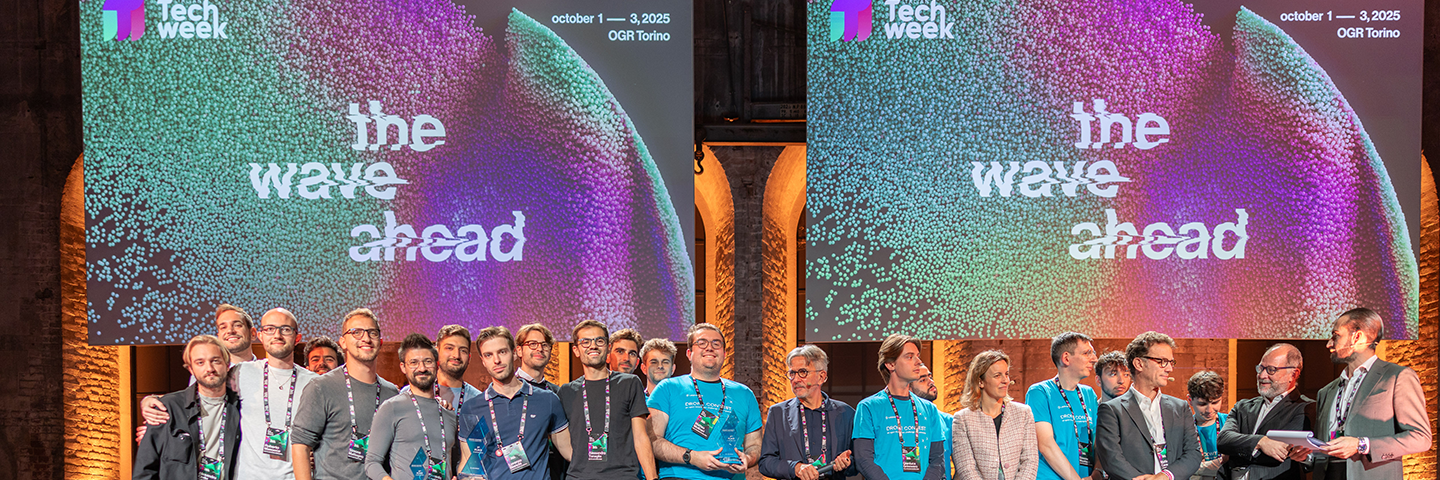
More than 50 university students from seven Italian universities participated in the 2025 Leonardo Drone Contest, held within the framework of Italian Tech Week. Now in its sixth edition, the initiative represents a concrete example of Open Innovation applied to Artificial Intelligence (AI) and unmanned systems. First place went to the team from Tor Vergata University, followed by Milan Polytechnic and the University of Naples Federico II.
The participants tested autonomous robotic platforms – both aerial (Unmanned Aerial Vehicles, UAVs) and ground-based (Unmanned Ground Vehicles, UGVs) – capable of moving through unknown environments without GNSS (Global Navigation Satellite System) signals, while simultaneously providing data and maps to a ground control station. At the heart of the challenge was the development of innovative localisation, navigation and human-machine collaboration solutions, powered by AI algorithms able to process collected data in real time.
This year’s edition further highlighted the strategic value of cooperation between heterogeneous systems, with the aim of planning and conducting coordinated missions between UAVs and UGVs. This multi-domain perspective tackles operational complexity by enabling AI-based solutions to reconstruct surrounding environments even in the absence of satellite support. Without GNSS signals, autonomous platforms must collaborate with one another, offering concrete contributions to the management of critical scenarios such as post-disaster inspections, surveys in hazardous or inaccessible areas, and emergency operations requiring speed, accuracy and safety.
Launched with the goal of fostering an “ecosystem” of innovation, the Drone Contest brings together the capabilities of large enterprises, universities (University of Rome Tor Vergata, Politecnico di Torino, Politecnico di Milano, Politecnico di Bari, Alma Mater Studiorum University of Bologna, Sant’Anna School of Advanced Studies in Pisa and University of Naples Federico II), small and medium-sized enterprises, and national spin-offs and start-ups. In addition to stimulating academic research, the initiative nurtures young talent and promotes the spread of key skills needed to address the technological challenges of the future.